
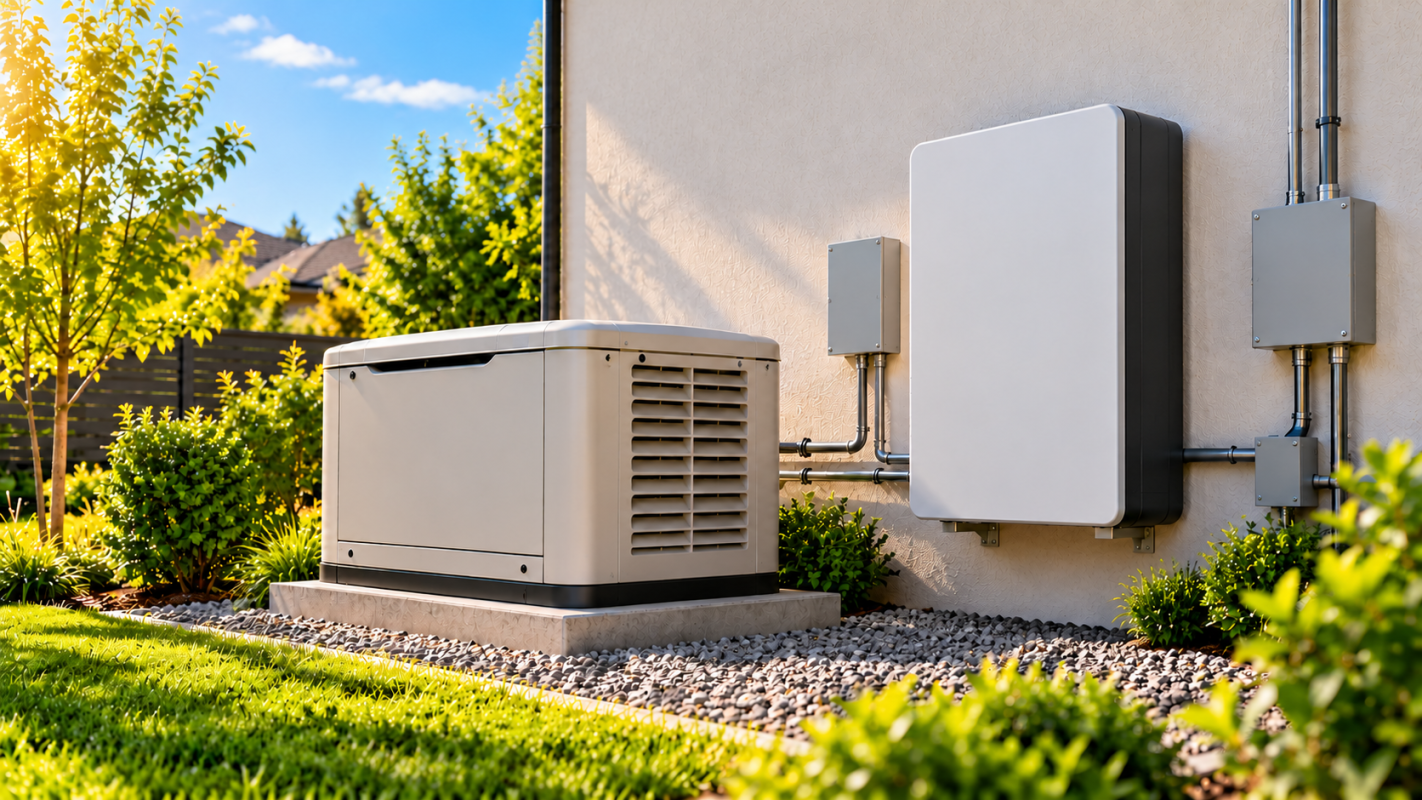
Even a few hours without electricity can cause serious problems. Hundreds of millions of Americans rely on electricity to run their AC, keep food and medicine from spoiling, and power other essential appliances. Unfortunately, power outages are lasting longer and happening more often as power grids age and demand rises.
To prepare, households across America are turning to backup power options like generators and home batteries. As battery prices continue to fall, more households, especially those with solar panels, are adding batteries to store extra energy and provide backup power.
Still, it can be hard to know how best to protect your home during an outage or which technology to choose. EasyHome can explain how each option works, compares the pros and cons, and answers common questions.
How does the technology behind backup power work?
Generators
Home generators are essentially small power plants. They run on gasoline, propane, natural gas, or diesel. Some models can use more than one fuel, giving homeowners more flexibility if one fuel isn't available.
When a generator runs, its engine burns fuel to create mechanical energy. That energy turns an alternator, which produces electricity.
With a standby generator, an automatic transfer switch connects the generator to your home's electrical system. When the switch detects a utility outage, it disconnects your home from the grid and transfers the electrical load to the generator. When utility power returns, the switch reconnects your home to the grid, and the generator shuts down after cooling.
The generator's control system manages startup and shutdown, monitors engine temperature and oil pressure, and can shut the generator down if it detects a problem.
Portable generators work a little differently. You generally need to start and connect them manually. But they work on the same basic principle, where a fuel-powered engine turns an alternator to produce electricity.
Batteries
A home battery is like a rechargeable power bank connected to your home's electrical system. Unlike generators, batteries don't generate electricity. Instead, they store it for later use.
The home battery stores electricity from the grid or a solar array. Batteries store electricity as direct current (DC), so an inverter converts it into alternating current (AC) that your household appliances use.
During a power outage, transfer equipment disconnects your home from the grid and switches it to battery power, allowing selected circuits to keep running.
A battery management system monitors temperature, voltage, and charging to keep the battery operating safely. A separate monitoring and control system manages charging, discharging, and which household circuits receive power.
Some electric vehicles can also provide backup power for a home. With vehicle-to-home (V2H) technology, a compatible EV can send electricity from its battery back to your home.
What are the tradeoffs of generators and battery backups?
Choosing the right backup power system will depend on your specific needs, budget, and outage risks. EasyHome can help you understand your options so that you make informed home improvement decisions.
| Generator | Battery Backup | |
|---|---|---|
| Power source | Generates power from fuel | Stores electricity for later use |
| How long it runs | As long as fuel is available | Until stored power runs out or until recharge |
| Noise & emissions | Noisy; produces on-site emissions | Quiet; no on-site emissions |
| Maintenance | Regular maintenance and refueling | Minimal needed; no refueling |
| Upfront cost | Generally lower | Generally higher |
| Solar integration? | Possible, but complex | Well suited for solar |
| During an outage | Automatic start for standby models; manual for portable | Automatic start; can recharge from solar or EV |
| Best for | Long outages and high-power loads | Short-to-moderate outages |
When does each make more or less sense?
A generator may make sense when:
• Outages last for days rather than hours. A generator can keep producing electricity as long as fuel is available.
• Your household regularly needs to power high-demand equipment like central AC, electric heating, well pumps, or other large appliances.
• Fuel is easy to get and relatively inexpensive.
A generator may not make sense when:
• You're concerned about noise or exhaust.
• Getting more fuel is expensive or difficult, especially during an emergency.
• You want to avoid regular maintenance and refueling.
• You don't have enough outdoor space for installation.
A backup battery may make sense when:
• Most outages are relatively short.
• You want to avoid exhaust fumes.
• Quiet operation matters to you.
• You want to minimize routine maintenance.
• You already have solar panels or are considering installing them.
• You don't have suitable outdoor space for a generator.
• You want selected circuits to switch to backup power automatically.
• You have time-of-use electricity rates and want to store power when rates are low, use it when rates are high, and keep backup power available during outages.
A backup battery may not make sense when:
• Keeping upfront costs low is your top priority.
• Outages often last for days.
• Your household needs to run high-power appliances for long periods.
How does rooftop solar work with a battery?
A standard grid-connected solar system can't provide backup power on its own. When the grid goes down, the solar system shuts off unless it has the right equipment to operate during an outage.
When solar panels are paired with a properly configured backup battery, they can recharge it during the day. This can extend your backup power beyond the battery's initial charge and help your system last through longer outages.
A battery can also save you money when the grid is working normally. If your utility uses time-of-use rates, you can charge the battery when electricity is cheaper and use that stored energy when rates are higher.
FAQs
General backup questions
How much does a home backup power system cost?
Costs vary widely. EnergySage estimates that a typical home generator costs about $7,000 and a 13.5-kWh home battery costs about $15,650 before incentives. Portable power stations can cost anywhere from $500 to more than $2,500, depending on their capacity.
How long can backup power last?
A generator can run as long as fuel is available. A battery can only supply power until its stored energy runs out, depending on how much electricity your household uses. Solar panels can recharge it during an outage if the system is set up to do so.
Will backup power turn on automatically?
Permanently installed standby generators and properly configured home batteries can switch over automatically. Portable generators, however, require you to start and connect them manually.
What happens to my solar panels during a power outage?
A standard grid-connected system shuts down during an outage. With the right battery backup equipment, your solar panels can keep operating and recharge the battery.
Do I need an electrician to install backup power?
Permanently installed generators and home batteries require professional electrical work. Portable generators are simpler to set up, but connecting one to your home's electrical system requires the proper equipment. Never improvise a connection.
Generator questions
What size generator do I need?
It depends on which appliances and circuits you want to run. Consider both their normal power needs and the extra power they need when starting up. Add those requirements together, then choose a generator with enough capacity.
What's the difference between a portable and standby generator?
You can move a portable generator and start and connect it manually. A standby generator is permanently installed and can start automatically and transfer your home's electrical load when the grid goes down.
How long can a standby generator run?
A standby generator can potentially run for days if it has a continuous fuel supply and is properly maintained. Natural gas models connected to a utility line don't require you to refill a fuel tank.
What's the best fuel for a generator?
There's no single best option. Natural gas can provide a convenient, continuous fuel supply. Propane stores well, while gasoline is widely available for portable generators. Dual- and tri-fuel models give you more flexibility.
What happens if I run out of fuel?
The generator stops producing electricity. You'll need to restore its fuel supply before it can run again.
How often does a generator need maintenance?
Generators generally need more routine maintenance than batteries. This includes regular inspections, oil changes, and testing.
Can I use a generator during a storm?
Yes, but you must follow the manufacturer's safety instructions.
Where can I safely place my generator?
Fuel-burning generators must run outdoors in a well-ventilated area, away from doors, windows, and other openings. If they are not placed in safe spots, fuel generators raise the risk of carbon monoxide poisoning, which kills hundreds of Americans every year.
Battery FAQs
Can batteries power just one appliance or the whole house?
Both are possible. You can configure a battery system to power selected appliances or circuits instead of the whole house. With enough battery capacity, inverter power, and the right electrical setup, it can power the entire home, too. Battery capacity determines how much energy the system can store, while the inverter's power rating determines how much electricity it can supply at once.
Can a battery recharge from the grid?
Yes. Many battery systems can recharge from the utility grid or your home's solar panels.
Can all home batteries serve as backup batteries?
No. Arbitrage batteries do not provide backup power, but instead help homeowners take advantage of changing electricity rates. Backup batteries, on the other hand, do provide outage protection. Some batteries provide both functions, helping reduce electricity bills while adding resilience against outages.